

Las Vegas shooting: Did guns use bump-stocks to fire more?
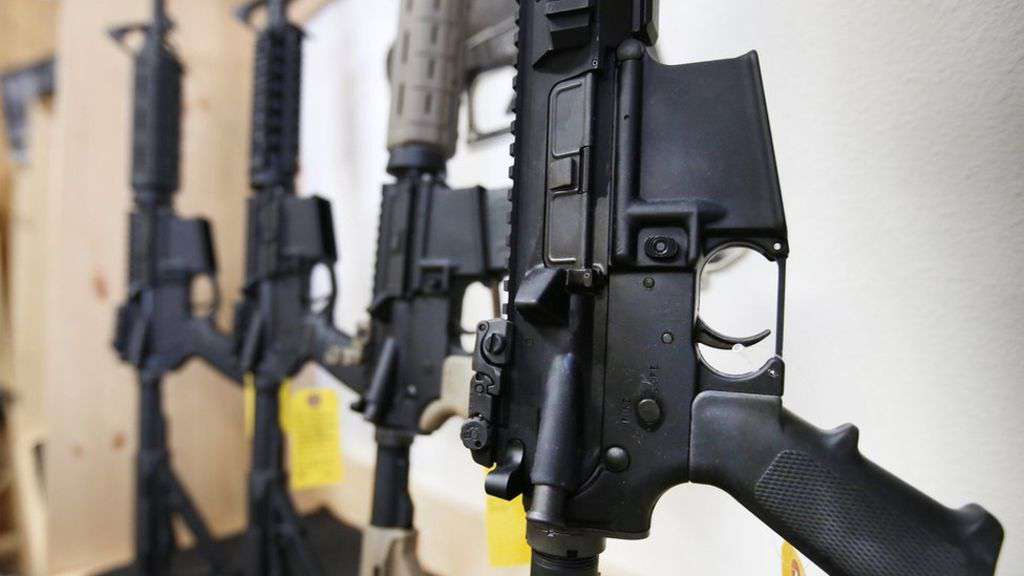
Image copyright Getty Images Image caption Bump-stocks can be fitted to standard semi-automatic rifles like the Colt AR-15
US media are reporting that the gunman who killed almost 60 people at a concert in Las Vegas on Sunday may have used legal but controversial accessories to allow semi-automatic rifles to fire hundreds of rounds per minute.
Two officials told the Associated Press that two devices known as “bump-stocks” had been found along with 23 guns inside Stephen Paddock’s room at the Mandalay Bay Resort and Casino.
It is not yet clear whether the stocks were fitted to the weapons that Paddock used in the massacre, but experts say they could explain the rapid rate of fire heard in videos shared on social media.
Audio analysis of one clip estimated that about 90 rounds were unleashed in only 10 seconds – far faster than a human being could repeatedly pull a trigger.
- Las Vegas shooting – what we know
- How Trump turned against gun control
- Tales of heroism emerge from Las Vegas
- Who was ex-accountant-turned-killer?
Since Congress passed the Firearm Owners’ Protection Act in 1986, it has been extremely difficult for civilians to buy new, fully automatic weapons, which reload automatically and fire continuously as long as the trigger is depressed.
Thousands of “grandfathered” weapons – those manufactured and registered before 1986 – can still be bought, but they are very expensive and all sales must be approved by the Bureau of Alcohol, Tobacco, Firearms and Explosives (ATF).
Media playback is unsupported on your device Media captionHow the horror unfolded – in two minutes
It is also illegal to modify the internal components of semi-automatic rifles – which typically manage about 60 aimed shots per minute – to make them fully automatic.
However, gun owners can legally buy accessories to increase the rate of fire.
One option is a “trigger crank“, “hellfire trigger”, or “gat crank”, which bolts on to the trigger guard of a semi-automatic rifle and depresses the trigger several times with every rotation.
A bump-stock, or “slide fire”, meanwhile harnesses a rifle’s recoil. It replaces the weapon’s stock, which is held against the shoulder, and allows the rest of the rifle to slide back and forward with every shot despite having no mechanical parts or springs.
Media playback is unsupported on your device Media captionWhat gunfire tells us about weapons used
The motion makes the trigger collide with, or bump, the shooter’s finger as long as they apply forward pressure with the non-shooting hand and rearward pressure with the shooting hand.
Following the Sandy Hook Elementary School shooting in Connecticut in 2012, California Senator Dianne Feinstein introduced a bill that sought to ban bump-stocks and similar devices, saying that manufacturers were exploiting “loopholes” to circumvent gun laws. However, the bill was defeated in the Senate.