
Turkey signs deal to get Russian S-400 air defence missiles
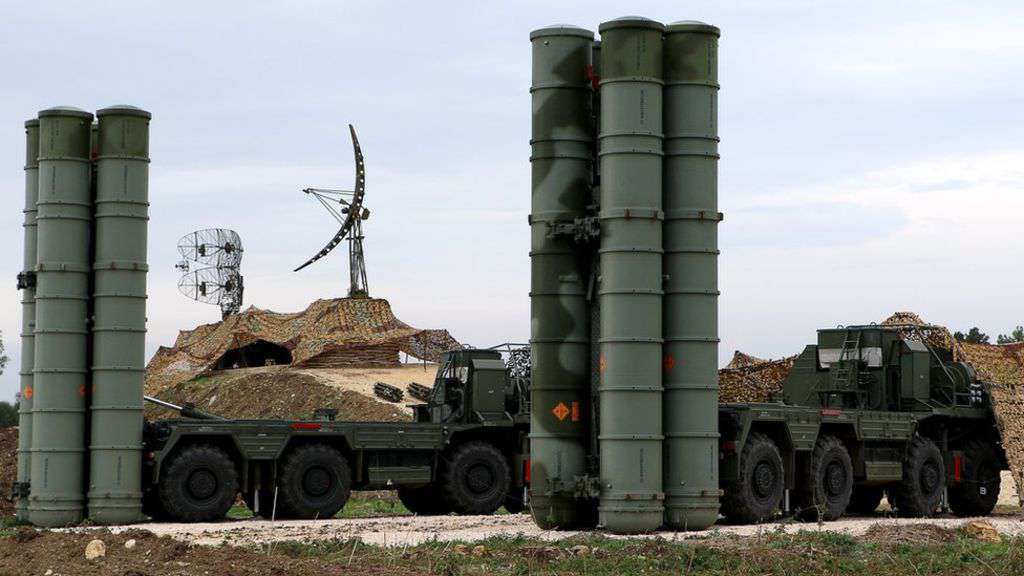
Image copyright AFP Image caption The S-400 missile system is deployed at Russia’s Hmeimim airbase in Syria
Turkey has signed a controversial deal with Russia to arm its forces with Russian S-400 anti-aircraft missiles.
President Recep Tayyip Erdogan said Ankara had already paid the deposit on the deal, estimated to be worth $2.5bn (£1.9bn).
Turkey has the second-largest army in Nato. Alliance members are urged to buy compatible weapons systems.
Turkey has been establishing closer links with Russia after its recent souring of ties with the US.
Turkey objects to US military support for the YPG Syrian Kurdish rebels, who are linked to rebel Kurds in Turkey.
Russia says the S-400 system has a range of 400km (248 miles) and can shoot down up to 80 targets simultaneously, aiming two missiles at each one.
Russia deployed the S-400 at its air force base near Latakia in Syria in December 2015, after Turkish jets had shot down a Russian Su-24 warplane on the Syria-Turkey border.
That incident caused a diplomatic rift between Russia and Turkey, but President Erdogan later patched up his quarrel with President Vladimir Putin.
Tensions within Nato
A military adviser to Mr Putin, Vladimir Kozhin, said the S-400 contract with Turkey was “strictly compatible with our strategic interests”. “On that score, one can quite understand the reaction of some Western countries who are trying to put pressure on Turkey.”
Image copyright Reuters Image caption Russia’s President Putin (R) and Turkey’s President Erdogan – back to business after patching up a quarrel
Mr Erdogan, quoted by Turkey’s Hurriyet daily, voiced displeasure with unnamed Western partners who were “seeking enormous amounts of money” for military drones.
He said Turkey had killed 90 YPG “terrorists” in the past week with Turkish drones – developed because the Western ones were too expensive.
“We are responsible for taking security measures for the defence of our country,” he stressed.
The BBC’s Mark Lowen in Turkey says the missile deal is clearly a rebuff to Nato, after the US and Germany withdrew Patriot air defence batteries from Turkey.
In 2015 Turkey had urged its Nato allies to keep those batteries positioned on the Turkish-Syrian border.
Turkey is also angry with the US for not extraditing Fethullah Gulen, the Muslim cleric who, according to Mr Erdogan, organised the July 2016 coup plot by rogue Turkish officers. Mr Gulen denied any involvement.
Manufacturer: Almaz-Antey arms firm; Deployment: Hmeimim airbase near Latakia – entered service in Russia in 2007; Range: 400km (248 miles); Speed: up to 4.8km (3 miles) per second; Max target height: 30km – can track up to 80 targets simultaneously; Types of target: aircraft, cruise missiles, medium-range missiles, drones, other airborne surveillance systems. (Sources: RIA Novosti, Russian 1TV.ru)
How it works
Not a good choice for Nato
By Jonathan Marcus, BBC defence correspondent
Turkey’s decision has both practical and political significance. Inevitably it will be seen as a further sign of Ankara’s gradual estrangement from its Western allies.
Turkey has been in the market for new air defences for some time. Four years ago it flirted with the idea of buying a Chinese system. But after pressure from its Nato allies it backed away from the deal.
Choosing a Russian system which will be hard, if not impossible, to integrate into Nato’s wider air defence system makes little strategic sense.
It was not that long ago – November 2015 – that Turkey actually shot down a Russian warplane that it said had intruded into its airspace from Syria.
But since then much has changed. On regional policy Ankara and Moscow are more closely aligned. And Turkey’s internal policies are seen as increasingly repressive by many of its allies.
In Nato generally the only Russian equipment used is legacy hardware in the forces of former Warsaw Pact countries. Greece also has an earlier Russian air defence system that was first sold to Cyprus.